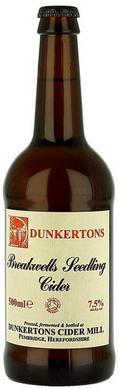
The second single varietal cider I've reviewed by Dunkertons of Herefordshire...
Style: Medium-dry / Western Counties / SV.
Appearance: Pale lemon / straw.
Nose: Rich, ripe apple aroma, floral perfumed.
Taste: Uniquely juicy, somewhat tropical, with a citric tartness, lightly done, and mid-to-low tannins that mainly appear in the finish. To me it gives a little more sweetness (a boiled-sweets sort of sweetness - but not artificial) than dryness, but saying that its particularly well balanced and very moreish!
Mouthfeel: Firm.
Carbonation: Mid range.
ABV: 7.5%
What's in it?: Browns' apples and sulphites.
Browns' cider apple is classed as a sharp, possessing a very high malic acid content and a low (approaching dessert apple) tannin level. For this cider, Dunkertons seem to have transformed the sharpness into a pleasurably tart tang and combined it with a lemon sherbert fruitiness. Despite being an SV, the cider feels so well balanced and integrated its as if it was made from a range of cider apples chosen with great consideration. This is a testament to both the Browns apple and Dunkertons' class as a cider maker. I've tried three of their ciders so far and all have been impressive. Oh and I love their labels too!
Showing posts with label Herefordshire. Show all posts
Wednesday, 27 February 2013
Thursday, 21 February 2013
Cider Review #3: Kingston Black (Gwatkin)
My first cider from Gwatkin, a smallish, independent family producer with a farm & orchard in Herefordshire.
Style: Dry / Western Counties / SV.
Appearance: Burnished gold colour.
Nose: Pungent, ripe apples.
Taste: Dry is the word for this cider! It lacks the juicy sweetness that so often comes with dry ciders, even though they are supposed to be dry! So on that basis it must be applauded. The dryness almost makes it feel a little thin or lightweight, but tannin is prevalent from the start as is a mild acidity which helps to balance the cider to a degree but not exactly pad it out. There's also a distinctive, very dry finish which ends all of a sudden and the only trace of having tasted this cider is a little grip in the aftertaste.
Mouthfeel: Mid to light for reasons mentioned.
Carbonation: Vigorous but not OTT.
ABV: 7%
What's in it?: Kingston Black apples and sulphites.
Kingston Black is a mild, bittersharp variety of cider apple regarded as having 'vintage quality', a rather nebulous term linked, from what I gather, to how well the cider will age (usually in oak). In addition to this 'definition' I think a vintage quality cider apple is one regarded as being able to carry an SV cider, i.e. a variety that has every aspect (tannin + acidity + sweetness) necessary to produce a good SV. This is analogous to the situation with wine where you have certain varieties of grape, e.g. Nebbiolo (of Barolo and Barbaresco) and Sangiovese (of Chianti), that produce wines well suited to (and that often improve with) ageing and that are more than capable of producing quality SVs precluding the need to blend.
As for this particular cider, well I wouldn't say its particularly well-rounded but then again its a single varietal so should be judged more on how well it represents the variety if you ask me, and less on how drinkable you may find it. After all, there are people who love their sharp, bitter ciders and there are those who like sweet, juicy ones. This will appeal to the former demographic but more importantly will give everyone an accurate taste of what Kingston Black is all about.
Tuesday, 19 February 2013
Cider Review #2: Dry Cider (Henney's)
This next cider is a dry one from Henney's, a big Herefordshire producer with its products in most supermarkets, but one with a reputation for quality as well as quantity.
Style: Dry / Western Counties.
Appearance: Deep gold and clear as a bell.
Nose: Medium-sweet apple aroma, very floral.
Taste: Despite its name, this cider doesn't strike me as particularly dry, mainly because a rich apple blossom aroma lends delicate sweetness. This is in turn counterbalanced by a dry acidic note fairly effectively. The finish showcases some nice grippy tannin. I'd describe this as thoroughly bittersweet with a dry finish. All in all then it's a fairly gentle cider but very well structured and appealing.
Mouthfeel: Firm
Carbonation: Much like the rest of the drink, the carbonation is definitely felt but its done with a light touch.
Henney's say this dry cider is the best selling of their range, which also features a medium (called England's Pride - review upcoming), a sweet (with added apple juice concentrate - at least they're honest about it!) and a still vintage. In line with the West Counties tradition, Henney's only use cider apples; specifically Dabinett, Ashton Bitter, Tremletts Bitter, Yarlington Mill (I've an SV of this cultivar by Gwatkins waiting to be drunk) and Michelin. All of Henney's ciders qualify for Herefordshire protected geographical indication (PGI) status although for some reason they, and most other cider producers, choose not to put this designation on the bottle. I guess they don't want people mistaking it for wine :p
Monday, 18 February 2013
Cider Review #1: Breakwells Seedling (Dunkertons)
My first cider review! And its a single varietal to boot, from the medium-sized but well respected cider mill, Dunkertons of Herefordshire.
Style: Medium-dry / Western Counties / single varietal.
Appearance: An appealing golden colour with a little haze.
Nose: Good strong, sweet and earthy fresh apple aroma
Taste: A semi-sharp acidity is present throughout in addition to a lovely full, fresh apple taste and a faint sweetness. Dry tannin dominates the finish, stretching it out indefinitely. In fact its certainly more intense than both Dunkertons Premium Organic cider and Co-ops Tillington Hills cider (which showcase no small amount of tannin themselves). The sensation this amount of tannin gives is not too far off (but not exactly equalling, either!) sucking on a sloe berry or more pertinently a crab apple, making tongue and gums stick to one another.
Mouthfeel: Quite full and a little oily.
Carbonation: A characteristic that tends to be on the low side in cider (in the dozen or so I've tried so far that is) compared to (too) many ales - a good thing in my opinion! In Breakwells the fizz is persistent but not over the top, helping the cider achieve a welcome freshness and drinkability, arguably needed at 7.5% ABV.
Breakwells Seedling is an early maturing apple cultivar first discovered in Monmouthshire about a century ago. It's a bittersharp cider apple meaning it has high levels of both tannin and malic acid, respectively. Both of these characteristics come across in a big way in the taste and that's what makes this such a good cider. The sweetness to begin with however is enough to prevent the drink becoming lopsided. Dunkertons themselves are a fully organic, family-run Herefordshire cider maker that started up in 1980. They also produce two other single varietals, from Browns and Court Royal apples.
Subscribe to:
Posts (Atom)